May 14, 2026
rrweb vs OpenReplay (2026): Which Should You Use?
OpenReplay gives your team a complete replay product. rrweb gives developers an open record-and-replay engine, with optional managed infrastructure.

Rogier Trimpe
@roggernautOpenReplay is a session replay product. rrweb is the open record-and-replay engine for putting session replay inside your own product. rrweb Cloud runs the infrastructure around that engine.
We maintain rrweb and run rrweb Cloud, so that is the perspective behind this comparison. OpenReplay is a separate project with its own recorder. Its @openreplay/tracker package is MIT-licensed and has no rrweb dependency.
The short comparison
| rrweb and rrweb Cloud | OpenReplay | |
|---|---|---|
| Product | Record-and-replay libraries, plus optional infrastructure | Complete replay application |
| Capture format | Typed JSON events | OpenReplay's own message format |
| Interface | You build or embed it | Dashboard, search, DevTools, analytics, and co-browsing |
| Hosting | Run the library anywhere; rrweb Cloud is managed | Self-hosted, usage-based Serverless, or managed Dedicated |
| License | MIT libraries; paid managed service | MIT tracker; AGPLv3 core; separate enterprise code |
| Managed pricing | 30,000 sessions included, then $1.60 per 1,000 | Serverless at $5.95 per 1,000; capacity-based Dedicated |
| Best fit | Replay inside your product or data pipeline | A replay tool used through OpenReplay's interface |
Pricing and licenses change. Check rrweb pricing, OpenReplay pricing, and the OpenReplay repository license before committing.
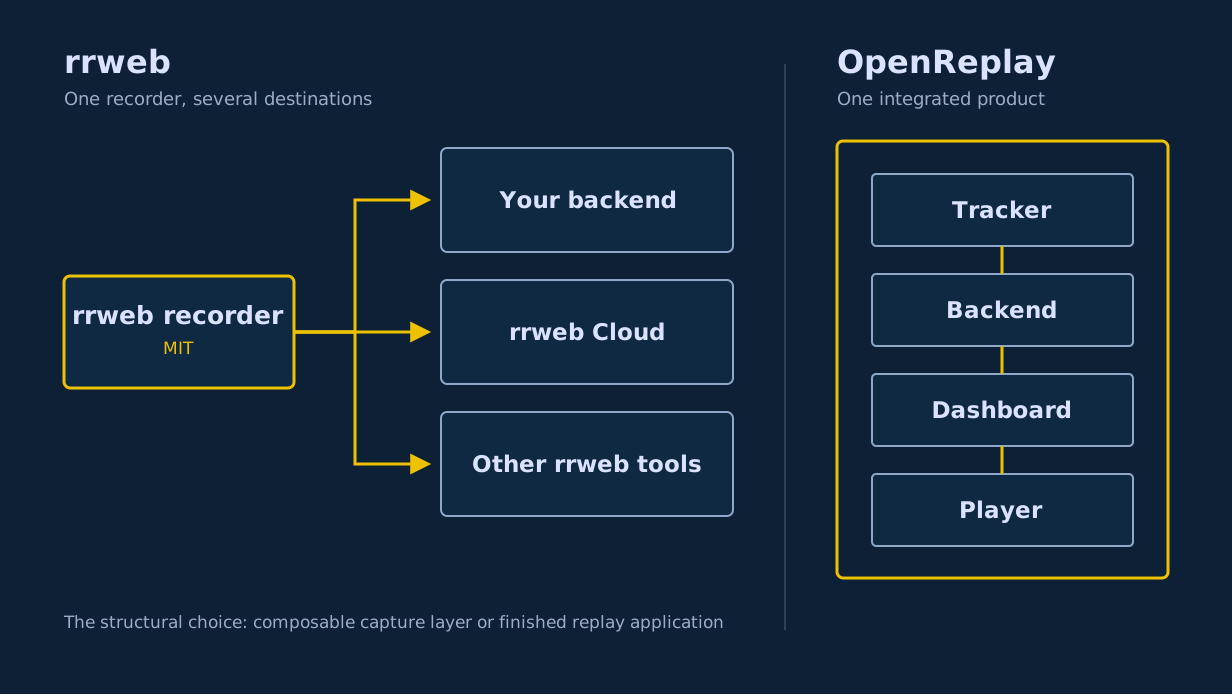
Two recorders, two event formats
rrweb records a typed JSON event stream. It takes a full DOM snapshot, then captures the mutations, input, scrolling, and other changes needed to reconstruct what happened. The open-source packages leave upload, storage, and presentation to you. Teams use them for support tools, QA runs, browser-agent traces, observability products, and replay platforms.
OpenReplay's tracker sends a different message format to the OpenReplay backend. That stack also captures network requests, console output, errors, and performance data. Search, analytics, DevTools, and co-browsing are already connected to the recorder and player.
The formats are open to inspection, but they are not interchangeable. Neither project documents a general converter, so old recordings still need their original player.
OpenReplay gives you the product
OpenReplay packages the recorder, backend, dashboard, search, DevTools, analytics, and co-browsing into one application. A team can deploy the open-source edition and start inspecting sessions. Its managed Dedicated plans run the same application on isolated infrastructure. This ready-made interface is its main advantage.
Self-hosting brings the usual responsibilities with it. Your team owns the services, storage, upgrades, backups, access controls, and incidents. The software license may cost nothing, but the system still needs an owner. Our self-hosted session replay guide covers that tradeoff in more detail.
rrweb gives you the engine
rrweb started with a narrower job: faithfully record a web page and replay it later. You can put the result beside a support ticket, failed test, agent run, or analytics event, while keeping control of the interface, tenancy model, metadata, retention, and permissions. The library remains MIT-licensed and works with any backend, including yours.
The product layer is real work. A useful replay system needs upload, storage, indexing, deduplication, query, access control, and a player integration. We have built those pieces more than once. The build vs buy guide explains what is involved.
Where rrweb Cloud fits
We built rrweb Cloud so teams could build the replay experience without rebuilding the infrastructure. It handles ingest, storage, indexing, filtering, and replay APIs, optimized for rrweb event data and operated by the maintainers.
The browser still records standard rrweb events, and your product still owns the interface. The cloud service replaces the backend work between record() and replay. It is optional; the library also works with your own backend or another rrweb-compatible service.
Managed pricing
OpenReplay Serverless includes the application. rrweb Cloud provides infrastructure for an experience you build. At the published usage rates, OpenReplay Serverless costs 3.7 times as much per 1,000 sessions, while rrweb Cloud includes the first 30,000 sessions each month.
| Sessions per month | rrweb Cloud | OpenReplay Serverless | OpenReplay Dedicated |
|---|---|---|---|
| 30,000 | $0 | $178.50 | O1 from $199, up to 50,000 |
| 100,000 | $112 | $595 | O2 from $399, up to 200,000 |
| 250,000 | $352 | $1,487.50 | O3 from $799, up to 500,000 |
| 500,000 | $752 | $2,975 | O3 from $799, up to 500,000 |
| 1,000,000 | $1,552 | $5,950 | Enterprise, contact OpenReplay |
The table excludes taxes, discounts, trials, and self-hosted infrastructure. OpenReplay lists O1 at $199 for up to 50,000 monthly sessions, O2 at $399 for up to 200,000, and O3 at $799 for up to 500,000. Workload shape can affect capacity.
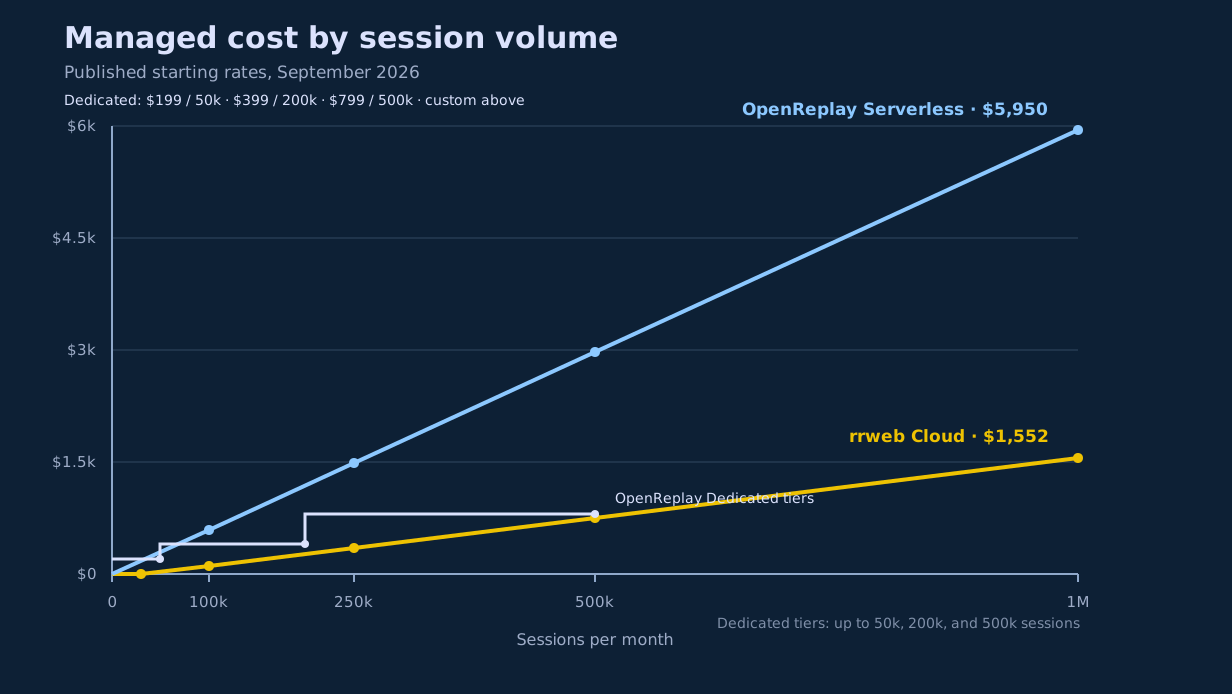
At those Dedicated capacities, rrweb Cloud costs $32 at 50,000 sessions, $272 at 200,000, and $752 at 500,000. OpenReplay Dedicated includes the complete application on isolated infrastructure, so the products cover different scopes. The open-source edition has no software fee, but leaves infrastructure and operations to your team. rrweb Cloud offers volume pricing above one million sessions.
The tradeoffs
With rrweb, you build the product around the recorder. rrweb Cloud handles the backend, while the interface remains yours. OpenReplay already includes co-browsing and an integrated DevTools dashboard.
With self-hosted OpenReplay, you operate a larger stack. Its repository also uses several licenses: the tracker is MIT, the core defaults to AGPLv3, and enterprise code has separate terms. Review them for your deployment.
Canvas-heavy applications and cross-origin frames need testing with either recorder. Both can add capture overhead and require extra configuration.
Our recommendation
Choose OpenReplay when you want a complete replay tool for your team. Its dashboard, DevTools, analytics, and co-browsing save substantial product work.
Choose rrweb when session replay belongs inside your application or data pipeline. You get direct access to the event stream and complete control over the experience around it.
Choose rrweb Cloud when you want that product control while the rrweb maintainers run the infrastructure.
At high volume, compare an OpenReplay Dedicated or enterprise quote with rrweb Cloud and self-hosting. Include the software you still need to build, maintenance, backups, upgrades, and on-call ownership.
FAQ
Is OpenReplay built on rrweb?
No. OpenReplay maintains its own MIT-licensed tracker. Its package manifest has no rrweb dependency.
Is OpenReplay free?
The open-source edition has no software fee and runs on infrastructure you provide. The core defaults to AGPLv3. OpenReplay also sells managed Dedicated hosting and an enterprise self-hosted edition.
Can I move recordings between the two?
Neither project documents a general conversion path. New sessions can switch recorders, while old recordings still need their original format and player.
Can I embed replay in my product?
rrweb's recorder and player are designed for embedding. OpenReplay centers its workflow on its application; its published embedding route uses an iframe, with service accounts in the enterprise edition.
Written by Rogier Trimpe
@roggernaut on GitHubGet started
Ready to try rrweb Cloud?
Free tier, no credit card required. Start recording sessions in minutes.
Sign up free